At 8:40 on a Monday morning, the vice president of sales asks a question that sounds like a database query:
How many European pharmaceutical distributors can handle cold-chain oncology products, and which ones have recently expanded?
The company sells temperature-monitoring and compliance software. A correct answer could define its target market for the next year.
By noon, Revenue Operations has exported the CRM. It contains 10,000 company records. The team filters for Europe, pharmaceuticals, logistics and distribution, then searches descriptions and notes for cold chain, temperature controlled and oncology. Six accounts remain.
The spreadsheet looks convincing. It contains company names, websites, countries, employee counts, account owners and contact details. It is also answering the wrong question.
It answers:
Which organizations already present in our CRM have fields or notes that resemble this market definition?
That is useful. It is not the same as identifying the market.
The CRM cannot show distributors the company has never encountered. Its industry labels may be too broad. One account may represent a corporate group while another represents a warehouse or subsidiary. A company may hold a wholesale-distribution authorization without describing itself online as a pharmaceutical distributor. A website may claim temperature-controlled logistics without establishing that the capability applies to medicinal products. An expansion may appear only in a local-language announcement, planning document or job posting.
The six rows are not necessarily wrong. They are a projection of the market through the company’s previous selling activity and database schema.
Before a seller can act, a GTM data system must answer four different questions:
- Who exists?
- Who fits?
- Why now?
- Who should we contact?
These questions are routinely collapsed into prospecting, enrichment, intent, account intelligence or lead generation. They should remain distinct. Each begins with a different object, requires different evidence and fails in a different way.
What This Book Means by “Market”
A market is not one timeless, objectively correct list.
In this book, a market is the set of organizations that meet a seller's commercial criteria on a given date. Those criteria may specify geography, company role, required capabilities or relationships, exclusions and the evidence needed to include an organization.
This is narrower than every business that could theoretically benefit from a product, and broader than the accounts already known to one seller.
It is also not a complete financial estimate of total addressable market. A company can meet those criteria while having little budget, weak demand or poor unit economics for the seller. Traditional TAM, serviceable-market and obtainable-market calculations add price, demand, competitive access and sales capacity. This book begins one layer earlier: establishing which real organizations plausibly satisfy the operational definition before revenue assumptions are applied.
Four related objects should not be confused:
| Object | Meaning |
|---|---|
| Market definition | The explicit rules for belonging, including time and evidence requirements |
| Candidate universe | Organizations with enough initial evidence to deserve evaluation |
| Qualified cohort | Candidates judged to satisfy the definition at the chosen publication threshold |
| CRM segment | The customer’s existing account records selected through available fields and history |
For the opening question, the market definition might require:
- an operating entity in specified European countries;
- current pharmaceutical wholesale activity;
- credible evidence of relevant temperature-controlled storage or distribution;
- oncology product or manufacturer exposure;
- and, for immediate prioritization, a qualifying expansion within the previous 18 months.
One customer may accept a company’s detailed facility documentation as evidence of cold-chain capability. Another may require a regulator, certification or named counterparty. The underlying sources can remain the same while the publication rule changes.
The market is therefore constructed from evidence, but it is not invented. The definition is a commercial choice; the organizations, licences, facilities, relationships and events are claims about the world that must be supported.
One Commercial Request, Four Data Problems
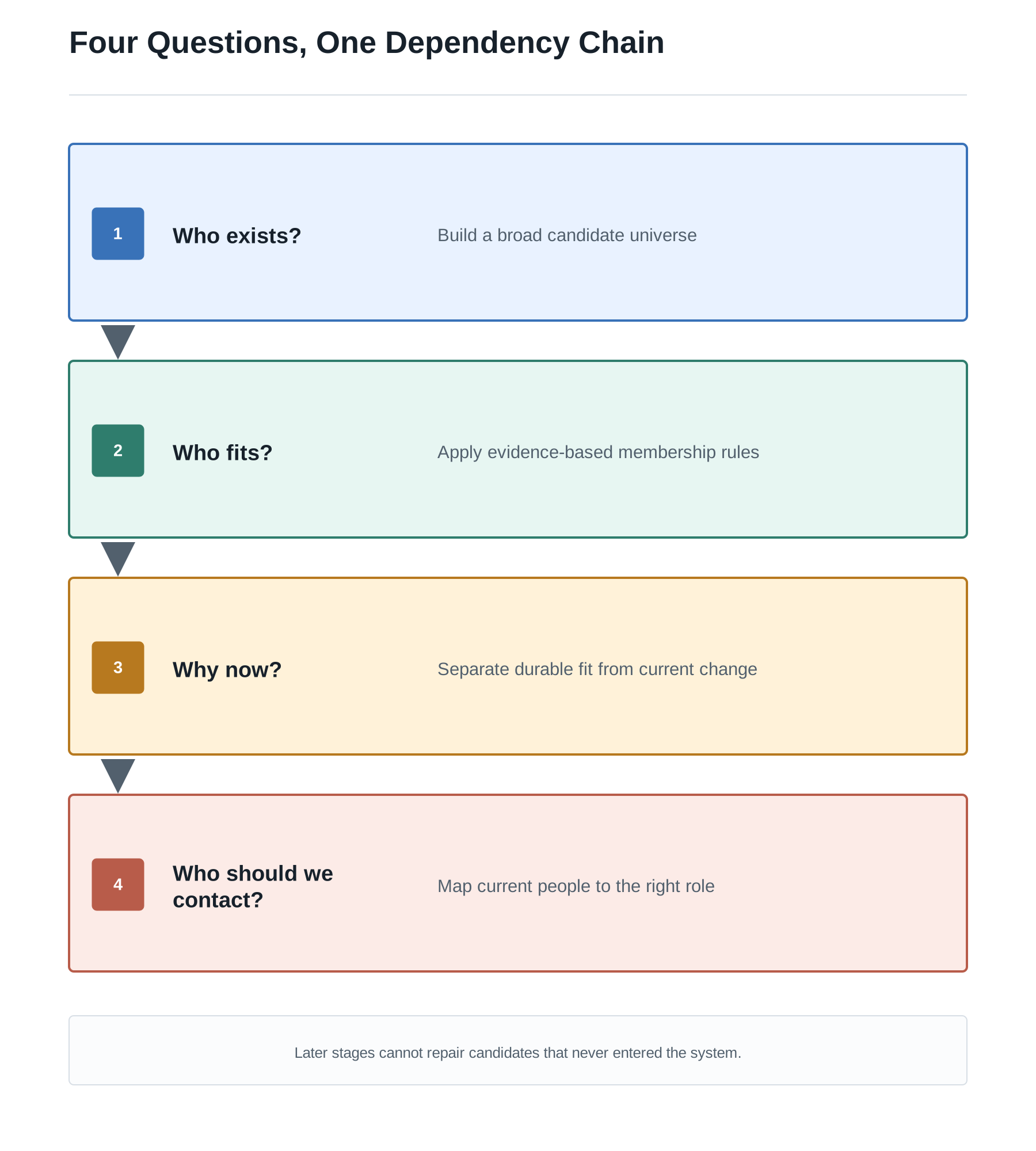
The four questions form a sequence because errors propagate downstream.
| Question | Required output | Characteristic failure |
|---|---|---|
| Who exists? | Broad candidate universe | Relevant organizations omitted |
| Who fits? | Evidence-based membership decisions | Irrelevant companies included or valid companies rejected |
| Why now? | Meaningful change or behavior | Activity mistaken for fit, or old events shown as new |
| Who should we contact? | Current people mapped to organization and role | Stale contacts or wrong buying group targeted |
If discovery misses a distributor, no later enrichment step can add attributes to it. If the wrong legal entity is selected, a valid contact may lead to the wrong operating company. If durable fit is confused with temporary activity, sellers may pursue active but irrelevant accounts. If the account is correct but its people data is stale, the final action still fails.
Missing rows are especially dangerous because they produce no visible error. A wrong phone number generates a bounce or failed call. A company that never entered the candidate set produces nothing.
The sequence is logical, not a rigid waterfall. Evidence found during contact research may reveal a subsidiary that should have been a separate candidate. A job change may expose an emerging business unit and cause the account’s fit to be re-evaluated. A seller’s correction may reveal that two supposed companies are one organization. Mature systems loop backward when later evidence changes an earlier judgment.
The separation still matters. Each loop should change the relevant claim rather than silently blending discovery, qualification and timing into one score.
Discovery Is Not Enrichment
Enrichment begins with a known object:
- a company name;
- a domain;
- an email address;
- a CRM account ID;
- or a customer-supplied list.
The provider adds fields such as industry, revenue, employee count, technologies, executives, contact channels or recent events. It can perform this work accurately while the starting universe remains badly incomplete.
Suppose the CRM contains 400 European pharmaceutical companies. An enrichment workflow correctly identifies 70 of them as distributors and attaches good evidence to 65. The output may have high precision among reviewed rows. It still cannot reveal whether another 150 relevant distributors were absent from the input. These numbers are illustrative, not an industry benchmark.
Discovery begins with the definition rather than a row:
Find organizations in Europe that currently distribute medicinal products, possess credible temperature-controlled capability and show evidence of oncology exposure.
No single source is likely to contain that table.
The candidate universe may have to combine regulatory authorizations for legal entities and locations, corporate registries for identity and ownership, company sites for facilities and services, manufacturer announcements and partner directories for commercial relationships, news and permits for operational changes, and professional data for responsible people.
The first discovery objective is broad candidate generation, not immediate proof that every candidate belongs. A generic logistics provider may enter the pool and later be excluded. A qualified but obscure distributor that never becomes a candidate cannot be recovered by a perfect classifier.
Enrichment asks, What can we add to these known rows? Discovery asks, Which rows should exist in the first place?